
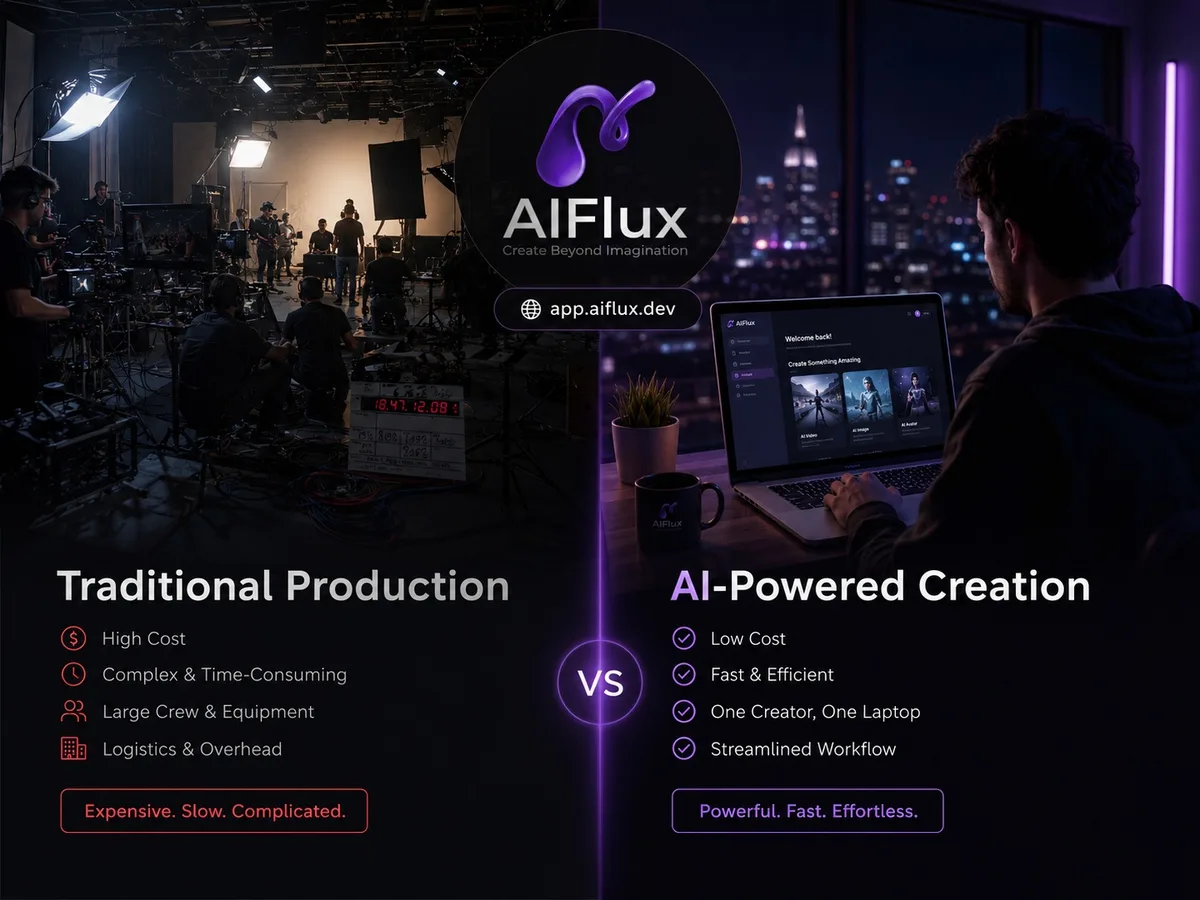
In 2026 the bottleneck for “professional video” is no longer money or technical access. It’s creative direction. The cheapest way to make a pro video has nothing to do with finding cheap labor or budget production gear — it’s about replacing the 5-person team workflow with a one-person AI workflow that does the same job in a tenth of the time at a thousandth of the cost.
This post is the actual cost comparison, with the workflow that gets you there, and an honest assessment of what AI still doesn’t replace.
What does a traditional professional video cost in 2026?
A “professional 30-second ad” produced traditionally in 2026 costs roughly:
| Line item | Low-end cost | Mid-tier cost |
|---|---|---|
| Videographer (half day) | $500 | $1,500 |
| Talent (1 actor) | $300 | $1,200 |
| Video editor | $400 | $1,500 |
| Colorist | $200 | $800 |
| Voice-over artist | $150 | $500 |
| Background music license | $50 | $300 |
| Studio rental (half day) | $200 | $800 |
| Sound design / mix | $150 | $600 |
| Project management / producer | $300 | $1,500 |
| Total | $2,250 | $8,700 |
Indicative 2026 rates for a small-to-mid-tier agency producing a 30s ad for a DTC brand. Premium production goes 3-5× higher.
For an indie creator or solo founder, $2,250-$8,700 per video is the line that “professional video” sits behind. Below that you have phone-shot UGC, which is fine for some channels but doesn’t carry the visual quality of paid media.
What does the same deliverable cost with AI in 2026?
Producing the same 30-second ad solo with AIFLUX in 2026:
| Line item | AIFLUX equivalent | Cost |
|---|---|---|
| “Videographer” | 6 × 5s 1080p video generations (Sora 2 / Seedance / Wan 2.7) | $0.50-$1.50 |
| “Talent” | LoRA-trained AI character (one-time training, reusable) | $2-$5 amortized |
| “Editor” | DaVinci Resolve free + auto-cut from prompt | $0 |
| “Colorist” | Already baked into AI model output | $0 |
| “Voice-over” | Qwen3 TTS (Italian, English, 20+ languages) | $0.05 for 30s script |
| “Background music” | Royalty-free library (Pixabay, etc.) | $0 |
| “Studio” | Generated in prompt | $0 |
| “Sound design” | AI-generated SFX or library | $0-$2 |
| “Producer” | You | your time |
| Total compute | $2.55-$8.55 |
The total compute cost for a 30-second professional-quality AI video in 2026 is $2-$25 depending on resolution, duration of each shot, and whether you use premium models (Sora 2) or budget models (Wan 2.7). Even at the high end you’re paying ~0.3% of what the traditional team costs.
What does the actual workflow look like?
A realistic one-person AI video workflow in 2026, end-to-end:
-
Script (15-30 minutes). Write 30 seconds of script. ChatGPT/Claude can speed this up but the creative direction is yours.
-
Storyboard (15 minutes). 6-8 shots, 3-5 seconds each. Just notes — what’s in frame, what’s the camera doing.
-
Generate hero shots (30-60 minutes). For each shot, run a Nano Banana Pro image to lock the composition, then send the image into a video model (Seedance I2V or Sora 2 I2V) for motion. Iterate 2-3 times per shot until happy. Cost: $1-$3 in compute per shot.
-
Generate voiceover (5 minutes). Drop script into Qwen3 TTS, pick voice, render. Cost: <$0.10 for 30s.
-
Cut in DaVinci or CapCut (30-60 minutes). Drop the 6-8 clips into a timeline, sync to VO, add transitions, color-correct if needed.
-
Music + sound design (15-30 minutes). Pull a track from Pixabay or generate ambient SFX.
-
Final export.
Total time: 2-4 hours solo for a polished 30-second ad. Total cost: $5-$25 in AIFLUX credits.
Compare to the 3-5 day timeline of a traditional small-agency production.
Where does AI still NOT replace humans in 2026?
Honest take on where the human is still required:
- Brand identity and creative direction. AI generates from your prompts. If your prompts are generic, the output is generic. Knowing what you want is the bottleneck, not getting it produced.
- Live-action with specific real people. AI-generated humans look great for stylized or anonymous-talent content. They are still distinguishable from a real specific person (you can’t make AI Brad Pitt convincingly for a paying client without licensing issues).
- Complex narrative storytelling. A 2-minute story with character development, emotional arc, and multi-shot continuity is harder for AI than a 6-shot ad. Doable but requires significant prompt-engineering skill.
- Live event coverage. Anything that happened in the real world this morning cannot be generated post-hoc with realism.
- Brand-sensitive corporate work. Major brands are still uncomfortable with 100% AI workflows due to perceived legal/PR risk, even where the law is clear. This is changing fast in 2026 but isn’t gone.
The pattern: AI replaces the production crew, not the creative direction. The skill that pays in 2026 is being a good creative director who can describe what they want clearly enough for the models to deliver it.
Which AI tools specifically do you need?
For producing a 30-second professional video, the minimum stack:
- One image generator for static shots, hero stills, thumbnails (Nano Banana Pro on AIFLUX, $0.18-$0.35 per image)
- One video generator for motion clips (Sora 2 / Seedance 2.0 / Wan 2.7 on AIFLUX, $0.10-$1.50 per 5s clip)
- One TTS for voice-over (Qwen3 TTS on AIFLUX, ~1 cent per 100 chars)
- One non-AI editor to cut it together (DaVinci Resolve free, CapCut free, Premiere)
On AIFLUX all four are in one credit wallet — no separate subscriptions, no five different logins, no five different content policies to remember.
For agencies producing high volumes of AI-model content, having every model on one credit wallet — with no per-tool subscription and no separate logins — is a big part of why a lot of that production has consolidated onto AIFLUX in 2026.
What about quality differences?
A fair 2026 quality comparison: a 30s ad produced solo with AI today is 80-90% as polished as a $2,500 small-agency production for the typical DTC/social-ad use case. It’s distinguishable to a trained eye but not to a target audience scrolling Instagram or watching a Meta ad.
The remaining 10-20% gap is closing every 4-6 months as the underlying models improve. By the end of 2026 the gap will be closer to 5%. For paid-media content, the price/performance trade-off already favors AI heavily — and has since mid-2025.
For broadcast TV, premium theatrical, or high-end documentary, the human team is still required in 2026. That market is also <5% of total commercial video production by volume.
Bottom line: how to actually start
- Sign up for AIFLUX — free credits on first signup to test workflows.
- Pick a 30-second concept you’d otherwise have to pay $2,000+ to produce.
- Storyboard it in 6-8 shots.
- Run the production solo over an evening using the workflow above.
- Compare the output to the brief you would have given an agency. If it hits 80%+, you’ve replaced a $2,500 line item in your business with a $25 one. If it doesn’t, you’ve learned exactly where your prompt-engineering needs work.
The math compounds: at 4 videos per month, you save $10,000+ per year vs. agency production while gaining iteration speed (3-5 day turnaround → 4 hours). At 20 videos per month, you’ve replaced an entire video team’s annual cost with one tool subscription that wasn’t even a subscription — see How does the unified credit wallet work?.