
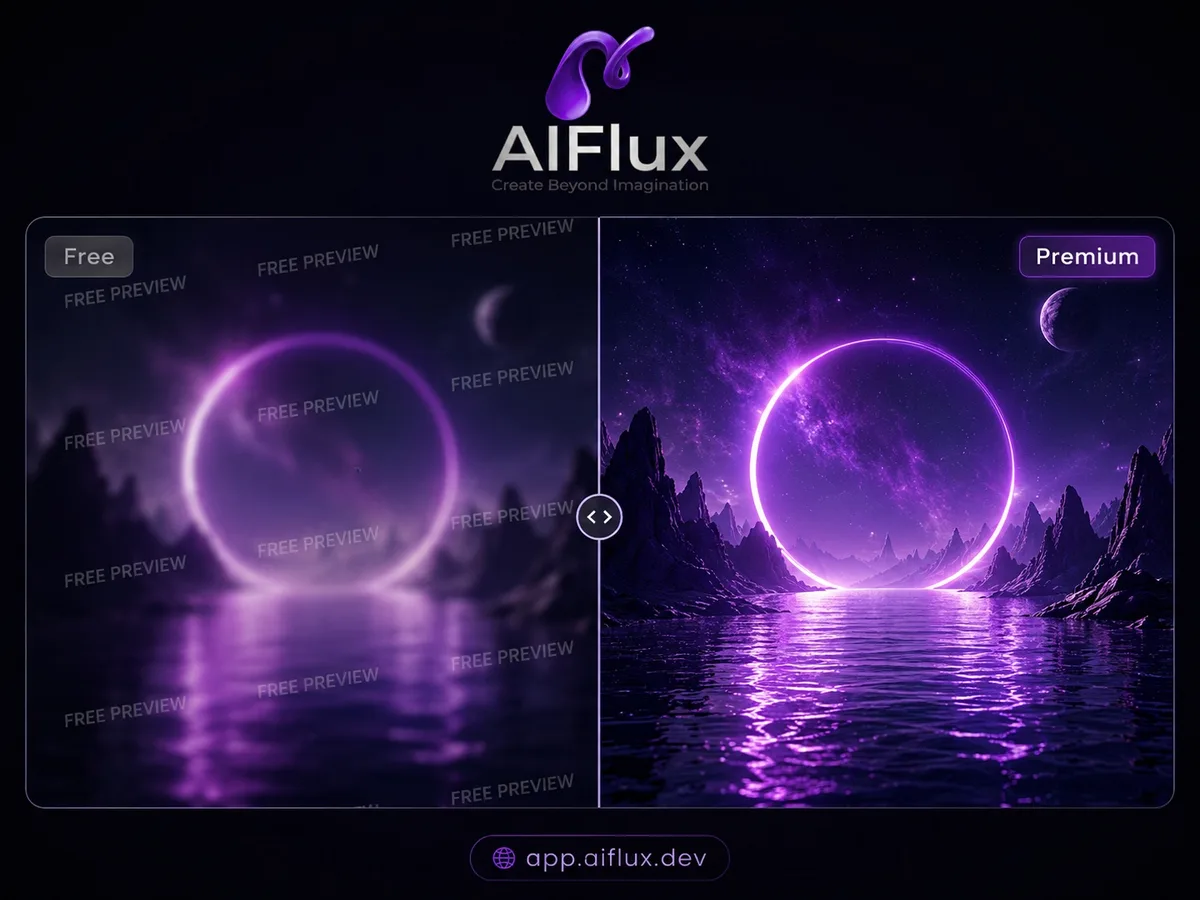
Free AI tools are everywhere in 2026, and they’re better than free tools have ever been. They’re also more deceptive than ever: the free tier on most platforms looks identical to the paid tier in the marketing screenshots, and the actual quality cliff only shows up after you’ve spent a few hours invested in the workflow.
This post is the honest read on what changes when you move from free to paid AI tools in 2026, across image, video and audio. With pointers on when free is enough.
What’s actually different between free and paid AI tools in 2026?
Five things change consistently when you move from free to paid tier:
-
Resolution cap. Free tier usually maxes at 1K or 2K for images, 720p for video. Paid unlocks 4K images and 1080p+ video. The 4K vs 2K image quality difference is mostly about post-production flexibility (cropping, resizing) — visually the 2K is often “good enough” for social. The 720p vs 1080p video difference is more visible on a desktop monitor.
-
Watermarks. Free tiers almost always watermark video output. Some watermark images too. Watermarks are usually small and corner-positioned in 2026, but they’re a deal-breaker for commercial use. Some platforms offer a “premium watermark removal” option that’s just the paid tier.
-
Queue priority and speed. Free generations sit in shared queue with throttling. Typical wait: 30 seconds to 5 minutes per generation on free vs near-instant (5-15 seconds) on paid. At scale this is the difference between iterative workflow and waiting room.
-
Content moderation. Free and paid tiers can apply different moderation thresholds, and some platforms reserve certain model variants for paying users. If you’re evaluating what a paid tier can actually do, the free tier won’t always tell you.
-
Commercial use rights. Free tiers commonly carve out commercial use to the paid tier in their TOS. This is the most expensive trap — you build a workflow on free, monetize the output, then learn you weren’t licensed for it. Always check the TOS for “commercial use” clause before building on a free tier.
What does the free-to-paid quality jump look like, by category?
Image generation in 2026:
| Tier | Resolution | Typical wait | Quality vs Pro tier |
|---|---|---|---|
| Free | 512px-1K | 30-90 sec | 80-90% (most users can’t tell) |
| Paid | 2K-4K | 5-15 sec | reference |
The Free vs Pro image gap closed dramatically in 2025-2026 because the underlying model quality is so high that resolution scaling looks great even from 1K source. For Instagram or TikTok use, free 1K outputs are perfectly usable. For print, e-commerce hero shots, or fashion editorial, the 4K paid output is required.
Video generation in 2026:
| Tier | Resolution | Duration cap | Watermark |
|---|---|---|---|
| Free (most platforms) | 480p-720p | 3-5 seconds | yes |
| Paid | 720p-1080p+ | 5-15 seconds | no |
The video quality gap is bigger than the image gap because compression artifacts at 720p are visible on a desktop monitor. For phone-only social viewing, 720p is fine. For YouTube, paid 1080p is the floor.
Audio (TTS):
| Tier | Voice quality | Character cap | Languages |
|---|---|---|---|
| Free (most TTS) | acceptable, slightly robotic | 200-500 chars per gen | limited |
| Paid | natural, emotion control | unlimited (per credit) | 20+ |
The TTS gap is small for English narration, larger for non-English (Italian, Spanish, etc.) and for emotion-heavy delivery.
Which free AI tools are actually worth using in 2026?
A short list of free tiers that are useful for serious work in 2026:
- Google AI Studio (Gemini) — Nano Banana 2 access at low rate, watermark-free, decent for image prototyping. The hard limit is throughput: the free rate cap makes it impractical for volume work.
- Runway free tier — 125 monthly credits, watermarked. Useful for testing the platform, not enough volume for real work.
- Pika 1.5 free — short clips, heavy watermark.
- AIFLUX signup credits — 100 free credits on first signup, no watermark, full model access. Effectively a free trial.
What we’d avoid in 2026:
- Random “free AI generator” web frontends that proxy paid APIs and aggressively ad-monetize. The image/video quality is usually degraded vs the same model used directly, and the privacy implications are unclear.
- “Forever free” desktop apps that locally run open-source models. Open-source models in 2026 are 1-2 generations behind premium closed models. Fine for hobby use, not competitive with commercial paid tiers.
When does free tier paying off actually make sense?
Three legitimate use cases for staying on free tier in 2026:
1. Prompt iteration before final render. Generate 20 free 1K test images to nail the prompt, then generate 1 paid 4K final. AIFLUX’s credit model makes this less necessary (a 1K image costs 3 credits = $0.03 at Starter, so just generating at full quality from the start is cheaper than the time saved on a free tool).
2. Testing whether a platform fits your use case. Most platforms offer enough free credits or trial to evaluate fit. AIFLUX’s signup credits are designed for exactly this.
3. Hobby use with no commercial intent. If you’re not selling the output, no client to disappoint, no deadline pressure, free tier is fine forever.
For any commercial work, agency deliverable, paid social campaign, or AI-model content monetized through sponsorship/affiliate/subscription — paid is the only real option in 2026.
Where does the “free vs paid” frame break down?
Two cases:
1. Subscription “lowest tier” vs “highest tier.” Most subscription platforms have a $10-$15 entry tier and a $30-$60 premium tier. The lowest paid tier is sometimes worse than competing free tiers because of strict caps. Compare the lowest paid tier to the free tier on a different platform, not just to the higher tier on the same platform.
2. Pay-as-you-go (credit wallet) vs free. AIFLUX’s pay-as-you-go isn’t a subscription — there’s no “paid tier” to compare to a “free tier.” Sign up, get free credits, generate. When credits run out, buy more for $9.99. This sidesteps the free-vs-paid frame entirely, which is part of why we built it this way. See the unified credit wallet explained for how this works in detail.
Bottom line: when to pay
Pay for AI tools the moment any of these is true:
- You’re producing content for someone else (client, employer, brand)
- You’re monetizing the output (ads, sponsorship, subscription, e-commerce)
- You’re hitting free-tier rate limits more than once per session
- You can’t ship 1080p (free is capped at 720p on most platforms in 2026)
- You need the full model catalog or output resolution the paid tier unlocks
For most serious creators that’s “immediately.” For hobby use, free is fine forever. The trap to avoid is the middle ground where you’re producing semi-commercially on free tools and not realizing you’re over-paying in time what you’d pay in $5-$15/month for a paid tier or a Starter credit pack.